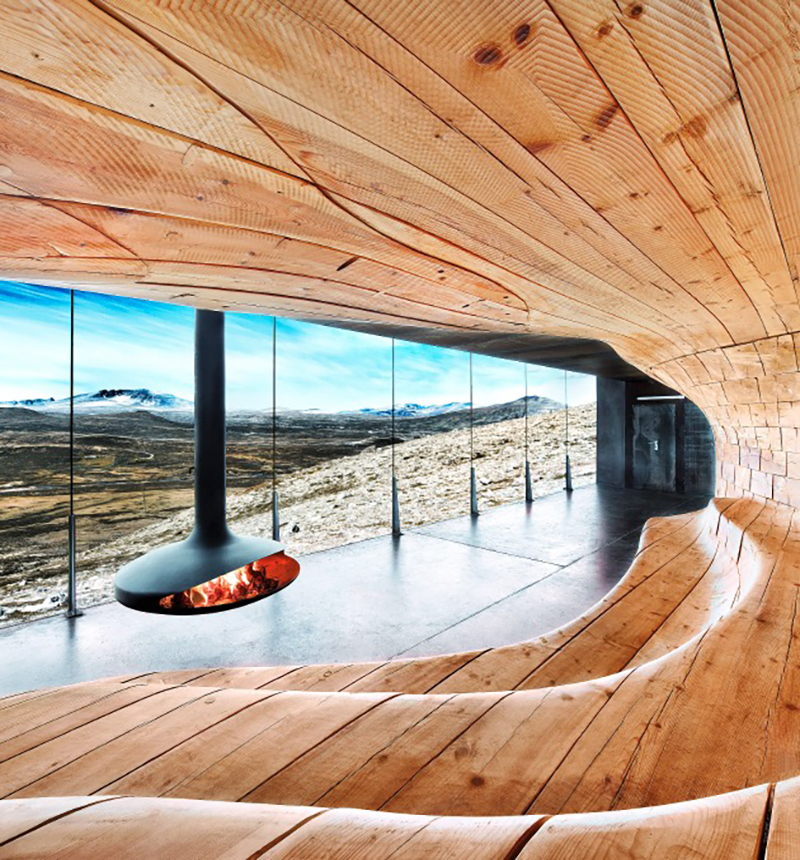
Choosing a suspended fireplace requires a careful reading of the space: understanding proportions, circulation flows, the building structure, and finding the right balance between thermal performance and intended use.
Through its collection of suspended fireplaces, Focus offers a diversity of models capable of responding to a wide range of architectural configurations and design intentions.
WHAT IS A SUSPENDED FIREPLACE AND WHY IS IT SO APPEALING?
The principle of suspension: a fireplace that frees the floor
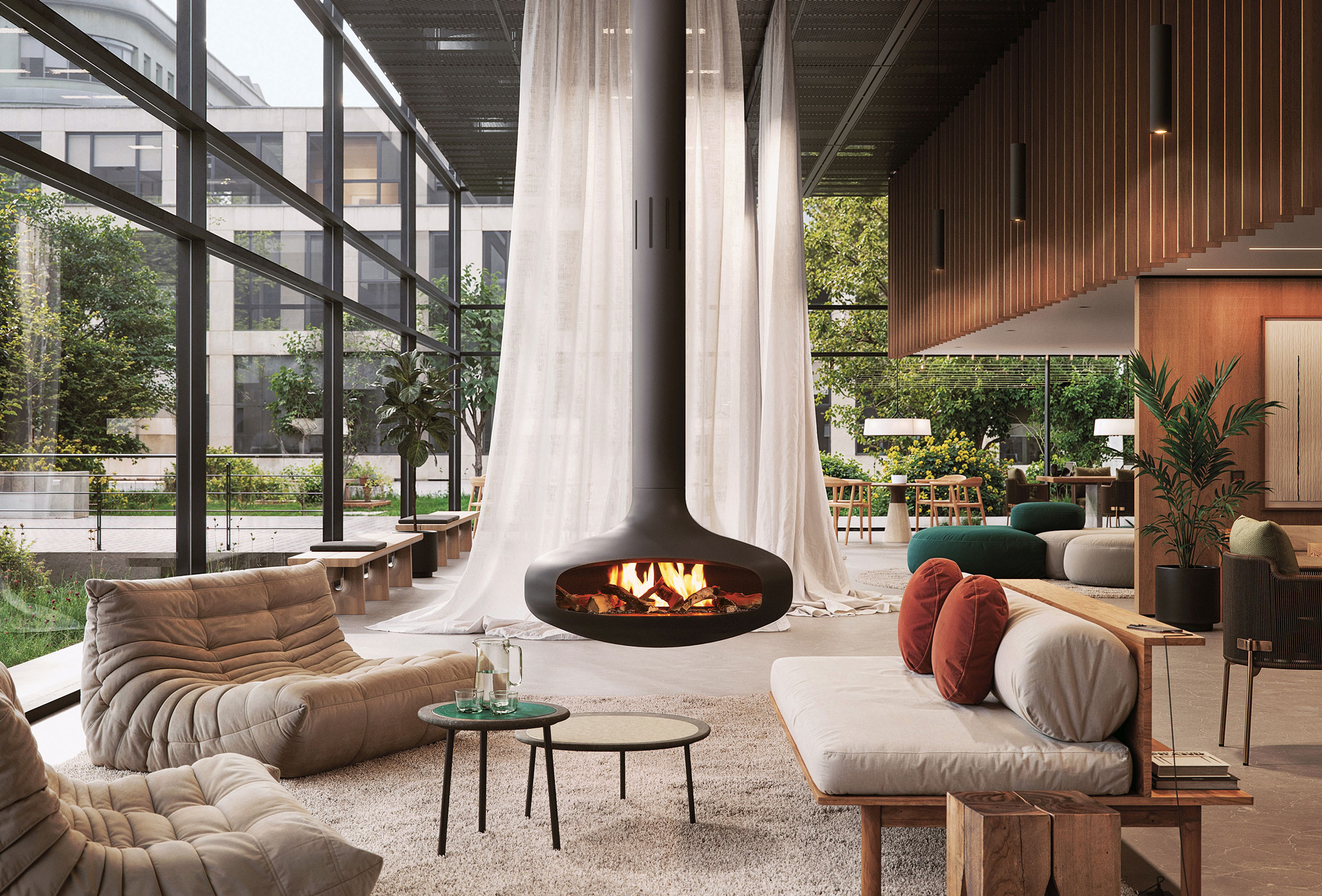
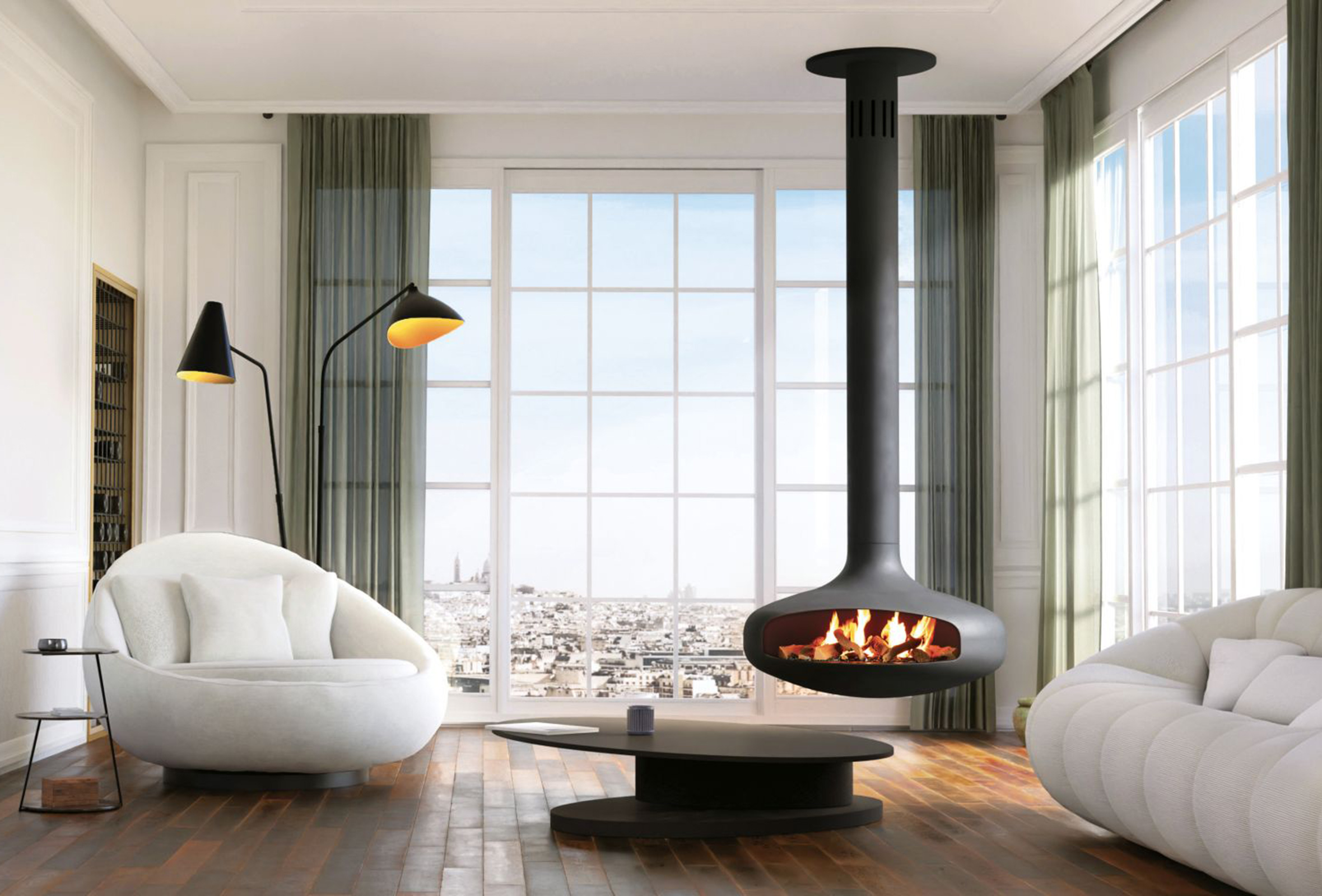
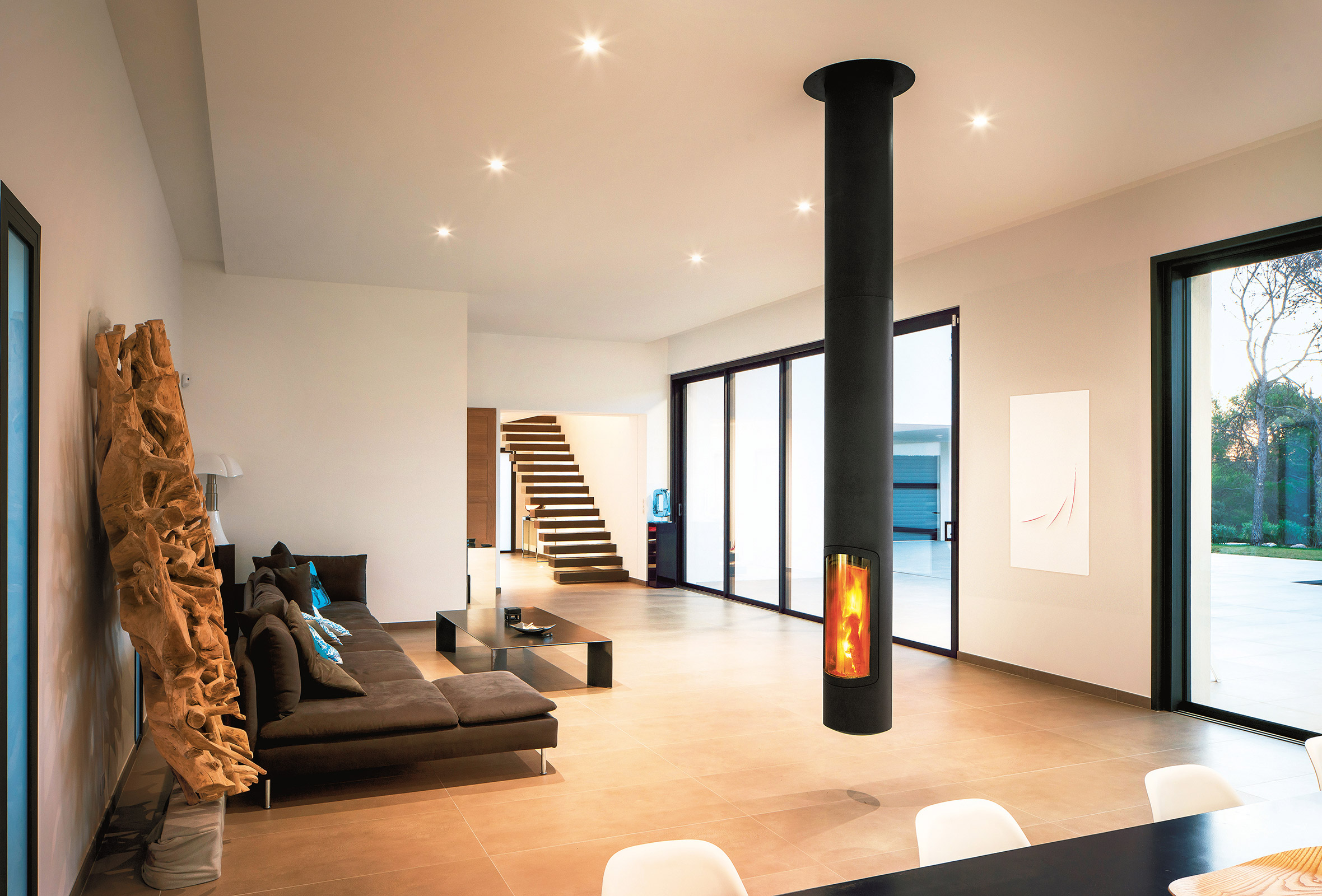
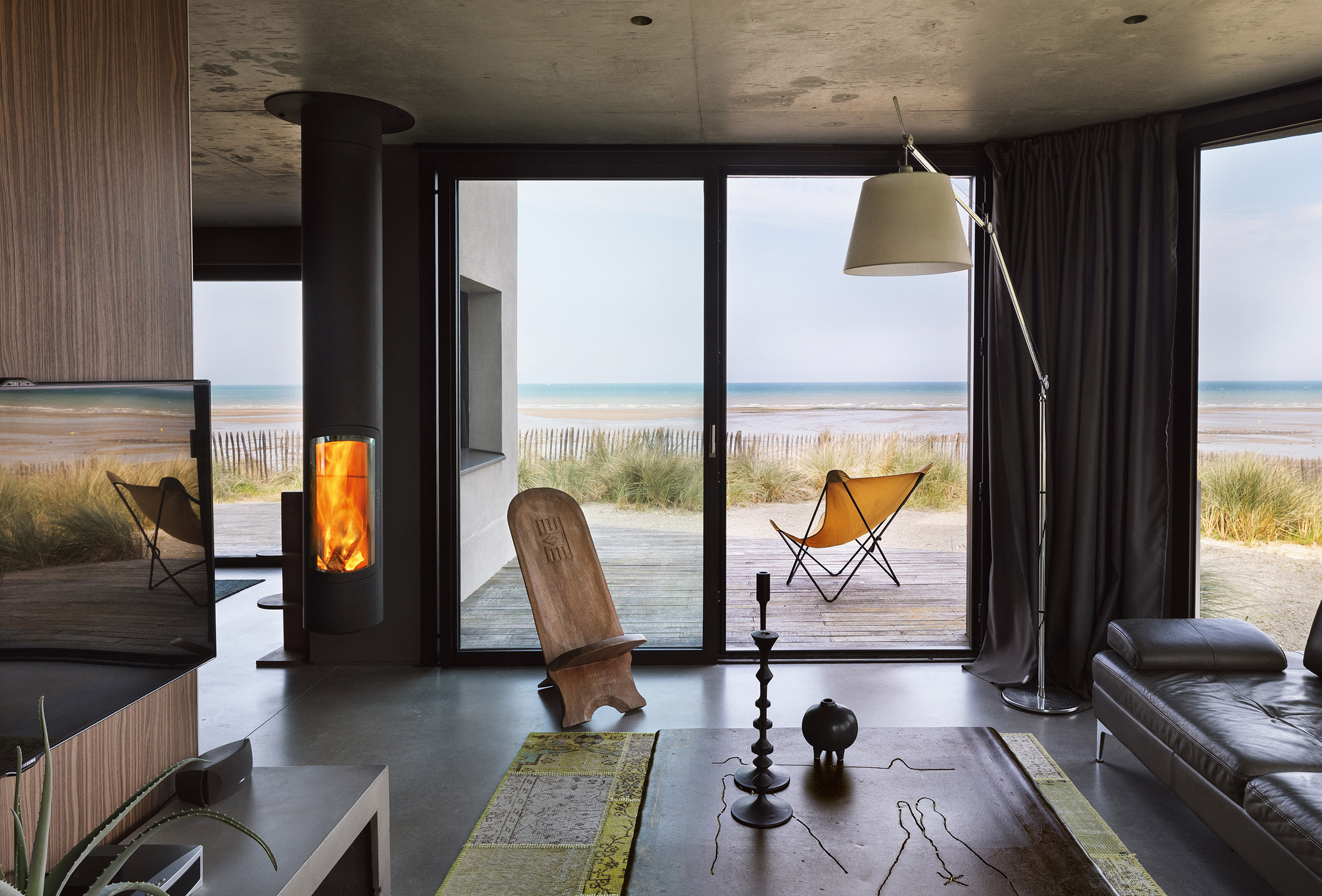
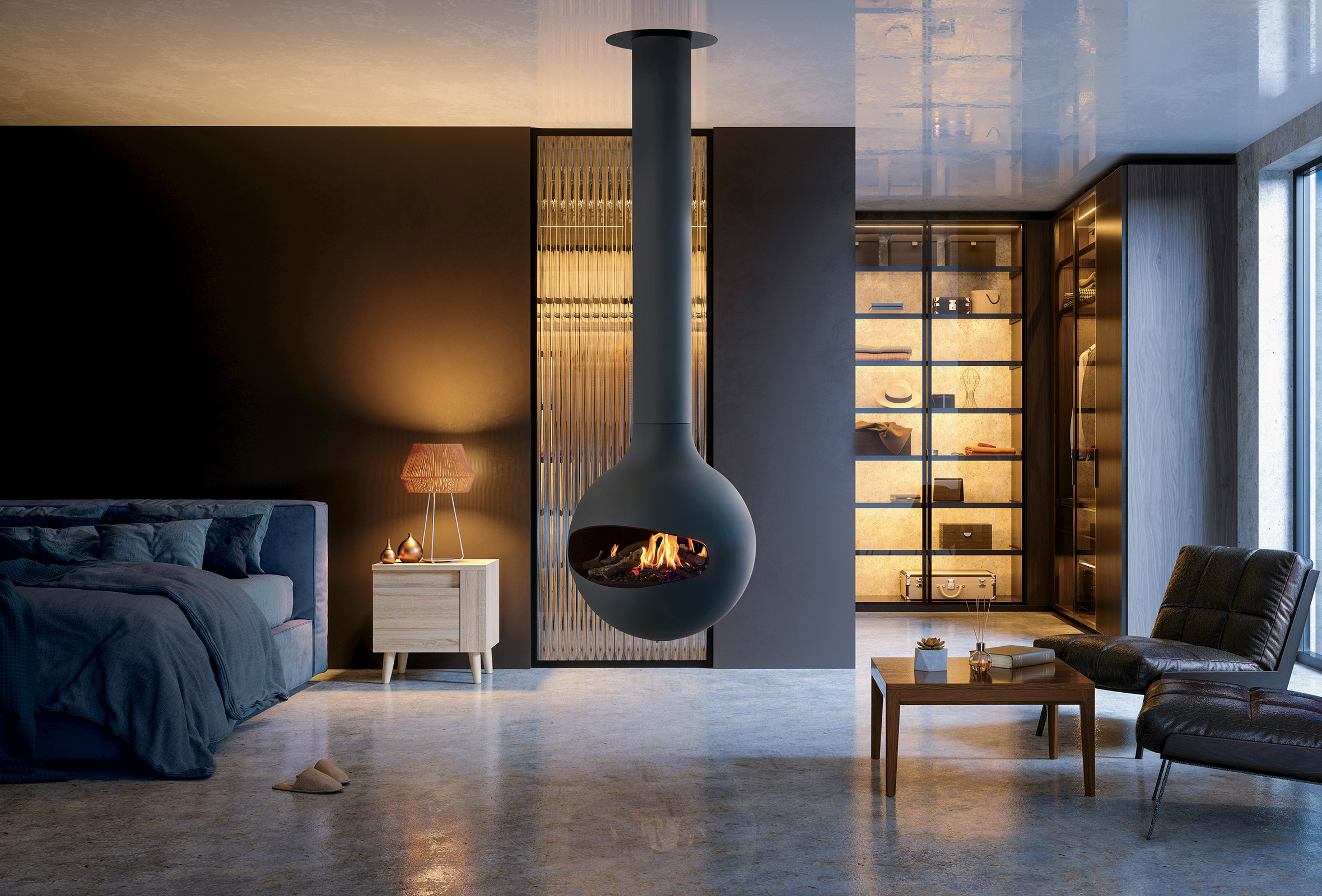
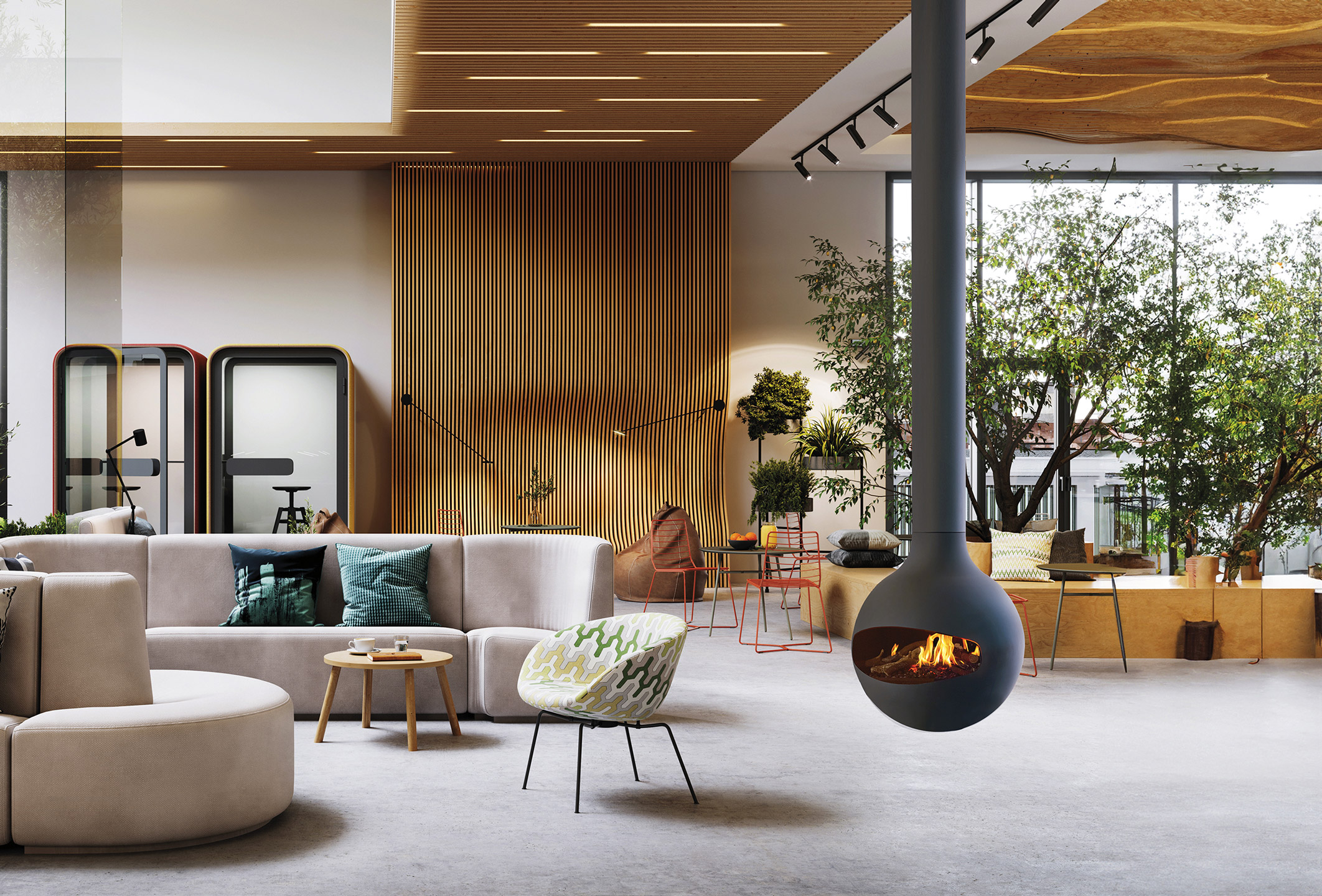
A suspended fireplace is distinguished by its anchoring system: rather than resting on the floor, it is fixed to the load-bearing ceiling structure through its flue. This construction principle frees the floor surface and places the fire in direct relationship with the architectural volume rather than the surrounding walls.
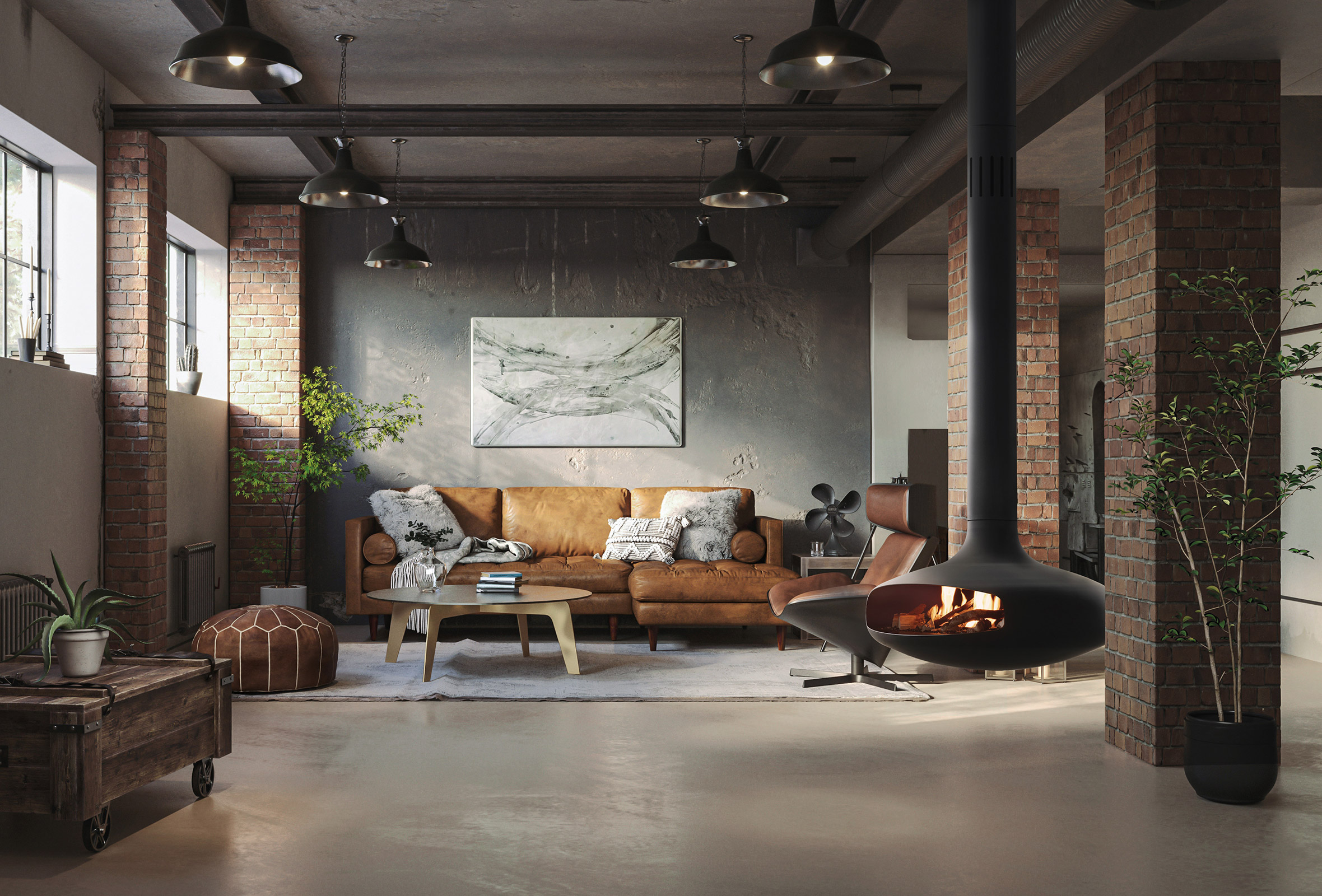
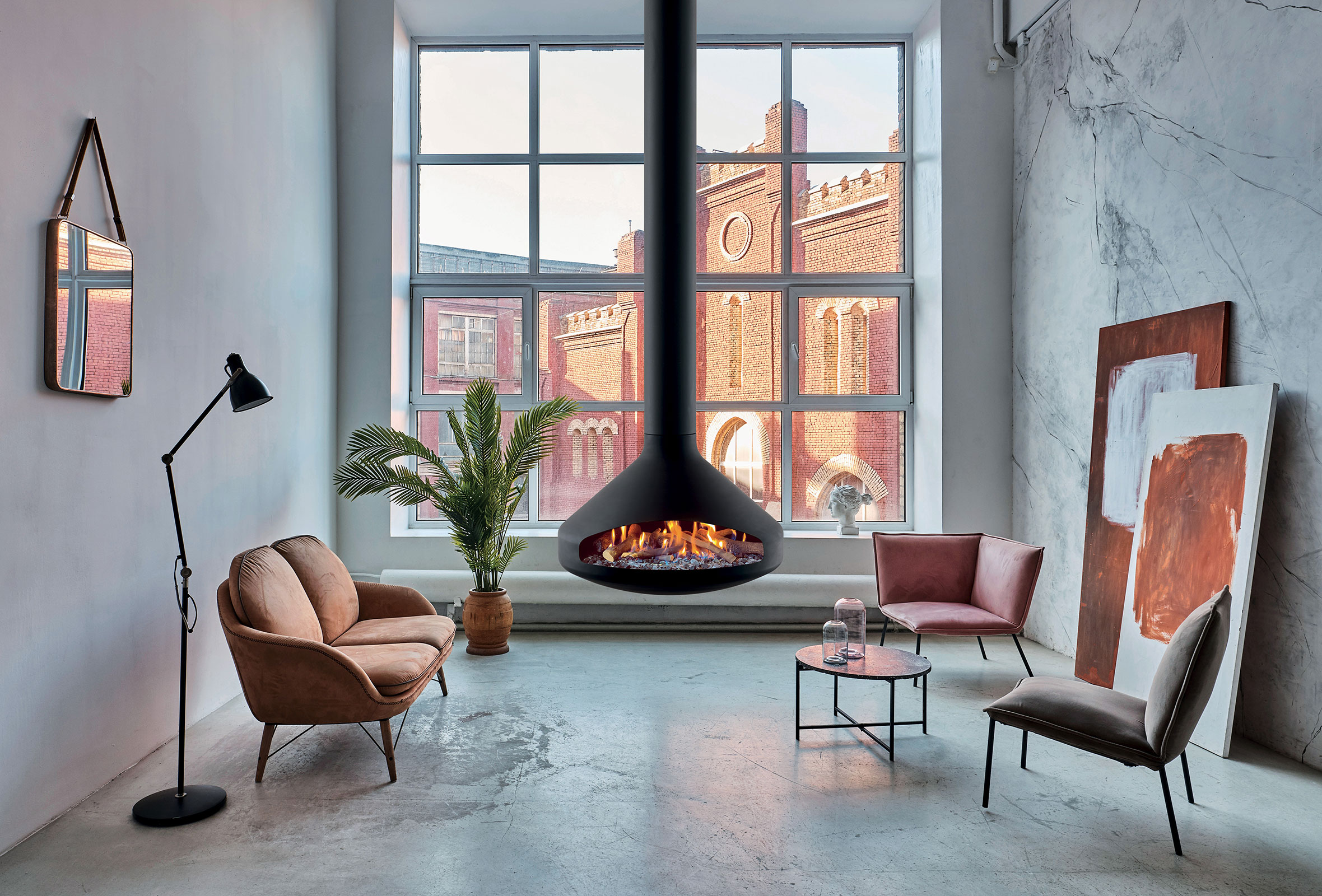
The flue is no longer a simple concealed technical element. It becomes a visible vertical line, fully contributing to the composition of the space. The suspended fireplace, designed to offer a more or less expansive view of the flames, may be fully or partially glazed and, in some cases, rotate up to 360 degrees.
Why does it transform the perception of space?
By detaching itself from the floor, the suspended fireplace immediately reshapes the perception of an interior. It frees surfaces, avoids visual interruptions at floor level and reshapes circulation.
The fire becomes an autonomous element positioned at the heart of the volume. This placement changes the way the space is experienced. The fireplace naturally attracts attention and organises life around it. When rotating, it allows the flames to be oriented freely and establishes a freer, more fluid and almost playful relationship with the fire.
The fully exposed flue plays a structuring role. It traces a vertical axis from the ceiling and anchors the fireplace within the height of the room. In this way, the suspended fireplace fully reveals the volume of the space.
The origin of the suspended fireplace: a new architectural dynamic
In 1968, Dominique Imbert — then a sculptor and future founder of Focus — imagined the world’s first suspended fireplace. Fire left the wall and detached itself from the floor to become fully integrated into the volume of the room.
This gesture gave birth to the Gyrofocus, a founding model introducing a double innovation: suspension and 360-degree rotation of the fireplace. Its organic black steel form, measuring 1.25 metres in diameter, created an immediately recognisable sculptural presence that has since become a design icon.
The intention was clear: to return fire to the centre of the living space. By freeing the fireplace from the wall, Dominique Imbert restored fire to its original, central and almost sacred position — designed to be shared and experienced as a gathering point.
With this creation, the fireplace changed status. The suspended fireplace became an autonomous object capable of structuring interior architecture. It initiated a lasting break with convention, giving rise to an entirely new category of fireplaces and transforming the way fire is conceived within the home.
HOW TO CHOOSE THE RIGHT SUSPENDED FIREPLACE ACCORDING TO THE CONFIGURATION OF THE SPACE?
Choosing a suspended fireplace is not purely an aesthetic decision. Its positioning and operating mode directly influence both spatial organisation and everyday use. Two parameters are essential: the way the fireplace integrates into the space and the intended use of the fire itself.
Defining the fireplace’s position within the volume of the room
Integrating a suspended fireplace requires a careful reading of the space. It becomes part of a volume that it reveals and structures. The room’s volume is decisive. It influences the choice of fireplace proportions as well as the length of the flue, whose vertical presence guides the eye upward. Generous ceiling height is a major advantage, allowing a large-scale model to fully express itself.
The analysis of circulation is equally essential. A suspended fireplace influences the way space is experienced. Depending on its position, it may reinforce an axis, mark a transition or become a point of convergence.
Finally, a suspended fireplace may be central, positioned at the heart of the room (see our dedicated article on central fireplaces), but it may also be offset, separate spaces or establish a dialogue with a wall. Circulation must remain fluid: movement around the fireplace should never feel constrained. It is this coherence in placement that allows the fireplace to find its place without ever constraining the space.
Choosing the energy source according to intended use
The choice of energy source is not based solely on technical considerations. It primarily derives from the intended use of the fire — heating or atmosphere — and the way it integrates into everyday life.
Wood remains a genuine heating solution. It offers an authentic sensory experience: visible flames, the crackling of the fire and the rhythm of combustion. It requires a certain availability and is part of a more ritualised relationship with fire.
Gas prioritises ease of use and control over the flames. Ignition is simple, the flame adjustable and intensity controlled. It responds to a desire for consistency.
Bioethanol and electric solutions, being smokeless and requiring no external flue, offer exceptional freedom of installation, both in houses and apartments, on ground floors or upper levels.
Each energy source therefore establishes a different relationship with the fire and its maintenance. The essential point is to create coherence between the space, the intended use and the operating system of the fireplace, so that it integrates naturally into daily life.
Installing a suspended fireplace
Suspending a fireplace requires a prior assessment of the building structure. Feasibility depends on the capacity of the structure to support the entire system: fireplace, flue and ceiling or roof fixing plate.
Installation also requires anticipation of the flue route, particularly where it passes through floors and exits through the roof. In new-build projects, these elements should ideally be integrated from the design phase, although adaptation remains possible in renovation projects.
In the case of a wood-burning fireplace, installation must imperatively be carried out above a non-combustible floor. This type of fireplace, generating high heat output, is incompatible with underfloor heating systems.
The positioning of the model must also comply with safety distances in relation to surrounding materials, as well as the ventilation conditions of the space, particularly in contemporary low-energy buildings.
Like any fireplace installation, a suspended model must comply with current regulations in order to guarantee a safe, durable and fully compliant installation.
Support from an approved Focus professional is essential to validate technical choices and ensure a safe, compliant and long-lasting installation.
Focus support, whatever the starting point of the project
Every suspended fireplace project may emerge from different contexts: a clearly defined intention, an ongoing reflection or a project led by an architect. Focus adapts to each situation in order to support the integration of the fireplace into the space.
This support relies on a network of approved partners trained specifically in suspended fireplace models. They provide on-site consultancy, measurements and analysis of structural constraints. Depending on the project, this work may be carried out alongside the architect through the prescription department in order to ensure coherence with the overall design approach.
The technical elements are then analysed by Focus, which validates technical compliance and, where necessary, adjusts the installation requirements. This organisation ensures perfect coherence between the model, its positioning and the characteristics of the space.
The objective is not to provide a standardised solution, but to deliver the right response for each project and each intended use.
FOCUS, PIONEER OF THE SUSPENDED FIREPLACE
A complete collection of suspended fireplaces
Over the decades, Dominique Imbert — pioneer of the suspended and rotating steel fireplace — continued his exploration of fire in suspension. This led to the creation of a structured collection of models recognisable through a shared design language. Forms, proportions, opening systems and views of the fire: each model offers a singular interpretation of the suspended fireplace.
Organic lines and refined forms define a consistent visual identity. This coherence makes it possible to respond to highly varied configurations, from the Slimfocus with its 33 cm diameter to the Gyrofocus, spectacular in scale with its 1.25-metre diameter and flying-saucer silhouette.
This diversity allows the fireplace to integrate into very different architectural environments, in response to volumes, intended uses and project ambitions.
Reissuing icons in response to contemporary challenges
Focus models, with their organic lines and sculptural dimensions, were not originally conceived to deliver environmental and energy performance. Unlike standardised approaches on the market, each Focus model is based on a specific design with its own combustion chamber. This singularity represented a major challenge when adapting them to Ecodesign wood-burning regulations and converting them to new energy sources — without ever altering the design.
After several years of research and development, Focus successfully met this challenge by adapting its iconic models to contemporary standards. The reissue of the Gyrofocus in its glazed Ecodesign version received multiple international distinctions. It notably won the Gold Award at the German Design Award 2023 in the “Excellent Product Design – Classic and Re-edition” category, as well as the Sustainability Mention at the Archiproducts Design Awards 2021, recognising the brand’s commitment to eco-design and controlled environmental impact.
This approach has also extended to other energy sources such as gas and bioethanol. The Ergofocus gas model, supplied through the ceiling, perfectly illustrates this evolution. Equipped with a patented system, it received a German Design Award in 2024 in Europe, alongside two American distinctions: the Good Design Award in 2023 and the New York Product Design Award in 2025.
A French manufacturing policy recognised with the EPV label
The French manufacturing of Focus models originates from a founding decision initiated by Dominique Imbert himself. It was reinforced in 1993 through the acquisition of the manufacture responsible for producing the models.
This industrial choice has been maintained over time, supported by the current management’s continued commitment to producing in France without relocation, despite market evolutions. This continuity preserves control over the manufacturing chain, enables innovation to be developed directly within the workshops and guarantees fidelity to the original design of each model.
Producing in France also reflects particular attention to manufacturing conditions, teams and environmental impact. This commitment is expressed through a responsible production approach rooted in its region and conceived with respect for resources.
This approach is recognised by the “Entreprise du Patrimoine Vivant” (EPV) label, awarded by the French state to only around one thousand companies in France for the excellence of their craftsmanship and expertise.








 Bioethanol
 Gas
Gas
 Wood
Wood